


EN ÕVUM
EN ÕVUM
·INTRODUCTION
EN ÕVUM is an ongoing project that I began during my UAL MA-Fine Art course. This project is designed to be in continuous change and evolution, laying the foundation for my upcoming artistic endeavors after graduation. It explores various artistic practices and will expand, contract, and adapt depending on the situation, time, place, message, and audience.
While at UAL, I am developing a proposal centered on the idea that, in a fractured world on the brink of collapse, EN ÕVUM serves as an invitation for reflection and transformation. This immersive work presents an unborn human form within a fragmented womb—a metaphor for humanity’s dormant state and the fragile, broken world we inhabit. The womb symbolizes the limited time we have on Earth and the urgent need to awaken and reconnect with ourselves, one another, and the planet.
Crafted from living mycelium, the sculpture will evolve and transform, blurring the boundary between human creation and nature’s ingenuity. Mycelium, as nature’s recycler and connector, represents a model of symbiosis and renewal, urging us to embrace collaboration over competition.
Soundscapes of mushroom electrical frequencies and dynamic lighting will create a sensory dialogue, merging art, biology, and technology. Through its materiality and transformation, EN ÕVUM reflects the impermanence of existence and the potential for regeneration.
This work is not just a sculpture but a living experience—a call to reimagine art as a process of co-creation and humanity as part of a larger, interconnected whole. It challenges us to awaken, rebuild, and foster connection for a more sustainable future.

·CRITICAL REFLECTION
This text outlines the work I plan to develop during my MA in Fine Art - Sculpture at UAL. It delves into the philosophy, material research, and broader practice underpinning my project.
My proposal centres on analysing, understanding, and applying mycelial structures within fine art. I aim to create a body of work that transcends traditional sculpture, embracing a broader spectrum of expression due to the profound complexity of the subject matter. Mycelium, as both a physical material and a metaphorical framework, allows me to challenge conventional boundaries in art, engaging with themes of interconnectedness, sustainability, and transformation.
Through reflection, analysis, and mindfulness, I, like many others, have recognized humanity’s accelerating descent toward self-destruction and environmental collapse. Our collective detachment from nature and our unsustainable practices have pushed us toward an inevitable extintion. I believe deeply in art's capacity to provoke positive change in humanity, and my work aspires to embody this potential. Rather than presenting a singular "piece," I envision an immersive experience—a catalyst for awareness, questioning, and inspiration. This project is not merely an exploration of form but an attempt to ignite meaningful conversations about humanity’s relationship with itself and the planet.
Mycelium has become central to my exploration, as its complexity aligns precisely with the message I wish to convey: the need for humanity to reconnect—with ourselves, the world, and the universe. The characteristics of mycelium make it a powerful symbol for addressing societal, environmental, and philosophical challenges. Mycelium's potential to inspire change spans multiple dimensions, each offering valuable lessons for humanity's improvement, regeneration, and harmony with the planet.
Key Perspectives of Mycelium as Inspiration
1. Recycling and Sustainability
Mycelium is nature's perfect recycler—decomposing and digesting organic matter to sustain life on Earth. This remarkable ability underscores the essential role of interconnected systems in maintaining ecological balance. It should prompt us to critically evaluate our recycling practices. Are current systems effective, or are they shaped by corporate narratives? How much of global pollution is genuinely caused by individual behaviours, and how much stems from large-scale industrial activities, unsustainable production processes, and unchecked corporate practices? These questions challenge the validity of the narratives we are often fed and demand deeper accountability from those in power. This theme can be further explored in the works of artist and corporations like: Marlowe Erickson & Phil Ross, Agnes Denes, Alexis Rockman, Studio Drift, Ecovative Design, Loop Industries, The Ellen MacArthur Foundation and MycoWorks.
2. Social Systems and Collaboration
Mycelium networks exemplify collaboration and mutual support, merging with other organisms to share nutrients and improve life. These networks act as a model of cooperation and mutual aid. In contrast, human societies often operate in ways that prioritize competition over collaboration, leading to social fragmentation and ecological harm. How can we reimagine our societal frameworks to emulate mycelium's symbiotic relationships? By mirroring this interconnected approach, we can work toward creating communities that prioritize collective well-being, resource sharing, and mutual support. For broader understanding of this specific theme Olafur Eliasson explores the themes of interconnectedness and collaboration engaging communities to address climate change, or Superflux with their "mitigation of Shock" installation, also Suzanne Simard on "Mother trees", or Joseph Beuys with his "7000 Oaks project", and Cuban artist Ana Mendieta who emphasize the symbiosis and interdependence between human and nature, addressing the fragmentation in modern society.
3. Urban Design and Biomimicry
The efficiency of mycelial networks offers profound insights into urban planning and resource distribution. Tokyo's underground network, inspired by slime mold, is one example of how biomimicry can revolutionize our understanding of complex systems. This example invites us to explore how natural phenomena like mycelium can inform sustainable city design. Could mycelium-inspired grids improve transportation systems, waste management, and even population distribution? By applying these principles, we could create more efficient, equitable, and resilient urban environments. There are some adventurers and innovative designers and studios that are working on this, such as Neri Oxman, Daan Roosegaarde, Terreform ONE, Philip Beesley and Anna Heringer, and surprisingly Arup.
4. Sexuality and Social Constructs
Nature, including mycelium, defies rigid constructs. It challenges us to reconsider societal norms around monogamy, heterosexuality, and other constructs that often govern human relationships. Are these norms inherent to humanity, or are they products of cultural and historical contexts? Mycelium’s queer nature, with its fluid and adaptive structures, encourages us to embrace diversity and question traditional binaries. This perspective invites deeper introspection into how societal norms shape our identities and relationships. To go deeper into this topic I've been reviewed and get inspiration from the works of Zanele Muholi, Cassils, Felix Gonzalez-Torres, and Heather Dewey-Hagborg.
These perspectives barely scratch the surface. As we uncover more about mycelium, new questions and possibilities arise. I wonder why research on these topics was suppressed in the 1970s. Could it be that the empowering potential of mycelium threatened systems of control? By understanding its applications and implications, we may unlock innovative solutions for sustainability and personal autonomy.
Given the magnitude of the message and the material's complexity, no single sculpture can fully encapsulate the narrative. My work will evolve alongside the subject, embodying growth, transformation, and revelation.
The central piece will depict a fully formed human being within a fragmented womb—still asleep, unborn—symbolizing humanity's urgent need to awaken from its dystopian slumber. The womb, represented as a fractured shell, evokes the broken world we inhabit and the transient nature of human existence. This shell also alludes to the miracle of life itself; the fact that we are alive is extraordinary, and we must use our time wisely to foster positive change. The sculpture will incorporate sound generated by mushroom electrical frequencies and dynamic lighting, creating an immersive sensory experience that engages multiple layers of perception.
The human figure will be crafted using a mycelium-based material. Experiments
will explore substrates like sugarcane bagasse, sawdust, and cardboard, with
mycelium acting as a natural binder. This choice of material underscores the
interconnectedness of life and reflects the ecological principles that guide the
project.
Two inoculation methods will be tested:
1. Grain Inoculation: Pre-colonized grain is mixed with the substrate.
2. Liquid Culture: A syringe injects liquid culture into the substrate.
Substrate textures—semi-blended and powdered—will be tested to identify optimal conditions for mycelium growth and detail retention. Once a solid structure forms, the sculpture will be cast in a mould and allowed to strengthen. After demoulding, it will develop in a Martha tent, growing fruiting bodies that alter the original form.
This transformation raises questions about authorship: Is the creator the artist or nature? The process is a collaboration between me and the environment, underscoring the beauty of co-creation and the necessity of symbiosis.
The sculpture’s evolution draws inspiration from kintsugi, the Japanese art of repairing ceramics with gold, symbolizing resilience and transformation. Similarly, my work repurposes broken materials, reflecting humanity's potential for renewal.
On a societal level, the piece asks: How broken are we? What will it take to mend our fractures? Mycelium teaches us that growth often emerges from decay, and by embracing this principle, we can rebuild more sustainable systems. Connection and mutual support are the "glue" we need to rebuild a thriving, sustainable world.
The complexity of this project has led me to question the traditional boundaries of artistic practice. Why isolate art into a singular field when collaboration can create more meaningful and impactful work? I encourage artists to approach their work holistically, drawing on diverse disciplines and perspectives to address the multifaceted challenges we face. By doing so, we can create art that not only reflects our world but actively seeks to improve it.
In conclusion, this project is more than a sculpture—it is a call to action, a dialogue, and an evolving exploration of humanity’s potential to reconnect with itself and the planet. Through the lens of mycelium, I aim to inspire a shift from exploitation to collaboration, envisioning a future where art, nature, and society grow together in harmony.


·MATERIAL RESEARCH
1.SELF STANDING STRUCTURE - COMPRESION TEST
With this experiment, the aim is to evaluate the strength of the mycelium network and its ability to self-support.
If successful, I will gain insight into how mycelium could function as a substitute for concrete in a hybrid concrete-and-metal structure. In this context, the mycelium (acting as concrete) would bear the compressive forces within the design. A catenary dome, shaped by the natural curve formed by a chain suspended under its own weight and then inverted, will be used to ensure that the structure operates fully under compression. This geometry is ideal for self-supporting structures, as it distributes forces efficiently along the curve, minimizing tensile stress and enhancing stability.
By observing the performance of the mycelium in this configuration, I will be able to understand the limitations of the material. These findings will inform the next stage: creating a sculpture with an internal metallic framework that better simulates the final conditions of the artwork, integrating both aesthetic and structural elements.

After 42 days the dome has been fully transformed into a new object, mutual collaboration between me and nature.

Front and isometric view of the catenary dome.

Fruiting getting bigger, just before spore releasing.
After 42 days the dome has been fully transformed into a new object, mutual collaboration between me and nature.
The following tests, Liquid Culture and Inoculated Grain Spawn, will allow me to gain a deeper understanding of the material properties, including its growth time, effectiveness in mycelium colonization, fruiting, contraction, and live specimen behavior. These tests will be conducted using the three main mixes, each with two variations of mycelium introduction. Each mix will also be tested in its two blended variations (powder blended and semi-blended).
To ensure broader chances of success, each test will be run twice, reducing the impact of potential contamination on the overall results.
The successful test will determine the final material for the sculpture.
2. LIQUID CULTURE TESTS
Liquid culture refers to mycelium spores suspended in a mix of water and a sugar source, such as malt, honey, or sugar. This mixture allows for the preservation of mycelium.
The tests will be conducted using three mixes, each with two variations.
The process involves placing each mix into a Mason jar, then sterilizing it in a pressure cooker until fully pasteurized. Once the jar reaches room temperature, liquid culture will be injected through an injection point located on the top of the lid. The jar will remain sealed until the mycelium spreads and fully colonizes the mix. Once colonized, the lid will be removed, allowing oxygen to enter the jar and enabling the mycelium to fruit.
This test will help me determine the best method to prevent contamination, assess the time needed for the mix to be colonized, and evaluate its implications for resistance. It is important to note that this process involves only mycelium and the mix binding together, without any additional elements. This differs from the inoculated grain tests.

Day 48, fruiting after spore release. The mix has fully compressed and deformed on the inside.

Fruiting detail.

Syringe inoculated rishi spores into mason jar with sugar cane bagasse left until dried.
Day 48, fruiting after spore release. The mix has fully compressed and deformed on the inside.
3.INOCULATED GRAIN SPAWN TESTS
Inoculated grain refers to sterilized grains, such as rye, millet, or wheat, that are colonized by mycelium. This method is commonly used in mushroom cultivation due to its ability to provide nutrients and act as a substrate for mycelium growth.The tests will be conducted using three types of mixes, each with two blend variations.The process involves mixing the grain into each pasteurized mix variation, ensuring the correct moisture content by leaving some water in the substrate. The mixed substrate with grain will then be placed into sterilized cubic moulds, which are equipped with a breathable membrane to allow a limited amount of oxygen to enter while preventing external contaminants.The moulds will be kept under constant observation until the mycelium fully colonizes the mix.
During this stage, I will evaluate how well the mycelium binds to the grain and the time required for full colonization.The goal of these tests is to determine the best mix type for successful colonization, minimize contamination risks, and assess the strength of the mycelium-grain bond. Unlike the liquid culture tests, this process introduces a nutrient-rich substrate, which may influence the growth rate but could also affect the material’s resistance.
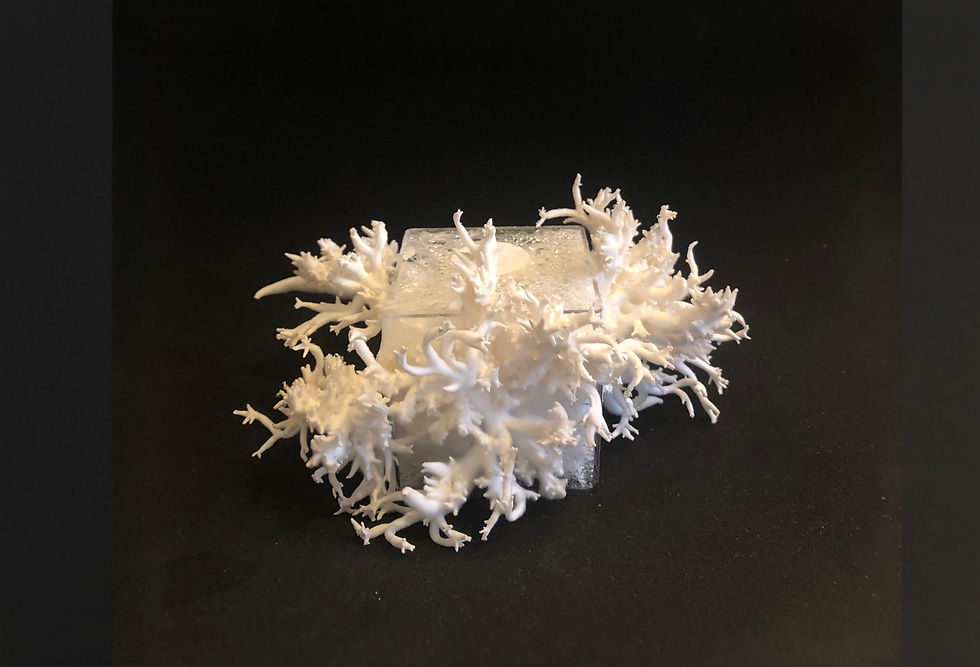
Day 42

Day 42

Day 21
Day 42
4. DETAIL REGISTER WITH INTERNAL METALLIC STRUCTURE TEST
This test aims to evaluate the material's ability to capture fine details when placed inside a silicone mold with an internal metallic structure. It also seeks to understand how material contraction affects the level of detail and whether this contraction occurs evenly. Additionally, the test examines how the internal metallic structure may influence the sculpture, considering that the material operates under compression forces while the metallic structure handles external tension forces.
To begin, I sculpted a male human figure in plasticine, which served as both the prototype for the mould and a case study. The muscles were exaggerated to assess the mycelium's capacity to replicate fine and intricate details, such as veins, hair, and the subtle contours of muscle surfaces. This also deepened my understanding of human anatomy, which has been a central focus of my sculptural practice. I chose a male form because male figures tend to have more pronounced musculature than female figures. The pose represents human strength, with the arms wide open, allowing me to observe how a hanging limb supported by a single point interacts with both the mycelium material and the metallic structure.
The process for this test began with constructing the metallic structure, followed by sculpting the human figure in plasticine. Next, a silicone mould was created, reinforced with a plaster and polymer jacket for stability. Once the mould was completed, the inoculated grain mix was poured into it and left to colonize in a sealed box to prevent contamination. After full colonization, the mold will be opened to allow the mycelium-shaped sculpture to fruit.
This test will help me evaluate all factors involved, including material contraction, the interaction between the metallic structure and the mycelium, and the overall capacity of the material to self-support. The insights gained will guide adjustments to the process, allowing me to refine variables and enhance my understanding of the material's behavior and potential applications.


Although most of the details weren't registered as expected, some of them did like the finger, which lead me to conclude that the sculpture was too filled making constraining the mycelium to properly register the fine details.
5.UNSUCCESFULL TESTS
Out of the 24 tests conducted, including both inoculated grain and liquid culture, only 2 became contaminated. Both instances occurred during the same test: Mix 1 (powder blended). Although the exact cause of the contamination remains uncertain, I believe it likely occurred during the preparation process rather than being an issue with the experiment itself. This assumption is based on the fact that all other tests were successful except these two, and both contaminated samples came from the same test. This suggests the contamination may have occurred during one of the following steps: the blending process, the mixing process, or the injection of the liquid cultures. In one of these stages, external contamination or inadequate sterilization of materials might have allowed contaminants to infiltrate the setup. The contamination presented as green mold, which competes with the mycelium for nutrients. This competition prevents the mycelium from fully developing and causes the main mix to rot, leading to severe compression of the material.


·FORMAL PROPOSAL
1.SKETCH'S


This sketch represent the feeling of how it would feel to be inside a womb.
2. SCALE MODEL

Front view 22 x 22 x 22 cms Plasticine

Lateral view 22 x 22 x 22 cms Plasticine

Front view upside down 22 x 22 x 22 cms Plasticine
Front view 22 x 22 x 22 cms Plasticine
3. MAIN PROPOSAL


4. PRESENTATION (WOMB)


Due to the complexity of the proposal, further layer will be explored, and integrated such as music, lightning as an initial stage.
·CONTEXT
1. DANH VO
After visiting Danh Vo’s exhibition at the White Cube Gallery, Mason’s Yard (October-November 2024), I was inspired by his use of substructures. These frameworks not only support but also redefine the sculptures, becoming integral to their identity.
This inspired me to consider how my sculpture might evolve as the mycelium grows and fruits. These organic additions will obscure parts of the figure, challenging traditional notions of form and completeness. This dynamic process blurs the boundary between natural phenomena and human expression, creating a profound and layered narrative.

1st century BCE Greco-Roman marble torso 134 x 64 x 61 cm

14th-century French limestone figure of Madonna and Child and pinewood 67 x 24 x 27.5 cm

1st century BCE Greco-Roman marble torso 134 x 64 x 61 cm
While waiting for my tests to develop and fruit, I conducted an exercise that better illustrates how an external growing volume could affect the original sculpture. This led me to the conclusion that I will take full control of the sculpture from point A to point B, which involves creating the figurative sculpture out of organic material. Beyond this, I will allow nature to take over and transform the sculpture into stage C—a mutual and organic collaboration between art, artist, and nature. These exploration will help me better understand the thin and delicate intersection between my collaboration with nature. It will reinforce the question of who truly creates the artwork: is it me, or is it nature? Am I merely being used by nature (of which I am a part) as a medium to reveal and explain what is unseen, or am I actively creating something, using natural materials to express my vision of the world?
This skecth helped me to understand how external volumes can redefine the original object (drawing), and see how my proposal might get affected after growing.

This skecth helped me to understand how external volumes can redefine the original object (drawing), and see how my proposal might get affected after growing.
2. OLIVIA BAX
Olivia Bax’s workshop took place at our studio, where she shared her unique vision of how to perceive objects and the world around us from a completely different perspective. She encouraged us to dematerialize and de-objectify things, stripping them down to their essence in order to uncover their true nature. This process, she explained, allows us to approach our work as artists with a universal understanding—if that is our goal—or to explore more creative and unconventional ways of engaging with art. By breaking free from traditional viewpoints, we are invited to reimagine and describe our artistic practice in new, thought-provoking ways.

Objects brought by the students, chosen at random, to create narratives.
Objects brought by the students, chosen at random, to create narratives.
After applying these learning and methodology into my work I wrote a description of my overall concept. Trying to capture the essence of something so huge and complicated in words I knew it would be challenging so I decided to make it as a descriptive poem...
THE SILENT ARCHITECT
I am the network, unseen and untamed,
stretching across the void,
white threads that twist and pulse,
a silent architect of life and decay.
I am invisible when I choose,
a shadow whispering truth.
I show you what I will,
and hide what I know.
I am the past, the present,
the future you fear to face.
I am connection and disruption,
monochrome and a riot of color,
wisdom that you’ve shunned,
a thread that’s been cut, tied,
and burned by your own hand.
I am the beginning, the end,
a cycle that spirals yet stops.
I rot so life can breathe,
I bring death so life can sing.
I decay and demand decay.
I am the puppet master,
controlling minds,
and yet I’ve been shackled.
So powerful, I’ve been vanished,
shushed, destroyed in your arrogance.
I am not of this world.
I create life in yours.
I carved your being,
and watched your gods crumble.
I am understanding and sharing,
I am intelligence and raw force,
a guide, a teacher,
your last breath and final question.
I am sporadic,
but I am truth,
elegant beyond the stars.
You? You are a visitor,
a passing gaze in my endless story,
a fleeting speck of irrelevance.
I am opportunity squandered,
a chance you won’t see again.
I am your beginning and end,
your final hope,
your unyielding reality.
I am utopia and dystopia,
a mirror you refuse to face.
I am power,
I am fragility.
I am the spark that lights the void,
the decay that fuels the flame.
I am your master, your servant,
your greatest fear, your deepest comfort.
I am silence in your chaos.
I am music, electricity, light.
I turn your screens on;
I make them meaningless.
I am your dream,
your nightmare,
the elegance you cannot reach.
I am the lens to tomorrow,
but you will go blind.
Your children will grow blind.
Unless they allow me to reveal
the way it doesn't have to be.
I am a recycler, a creator, a destroyer.
I am the thread that binds.
I am misunderstood.
I am wisdom.
I am sorrow.
I am the truth you cannot bear.
I am your last chance.
I am your world.
I am not yours.
I am.
I am you.
3. HOLLY HERNDON & MAT DRYHURST : "THE CALL"
In the Serpentine North Gallery, Holly Herndon and Mat Dryhurst are exhibiting their work The Call, an immersive exhibition that intertwines AI, church choirs, and the spectator. It emphasizes the transformative potential of AI to turn individuals into a collective, much like a choir. The project focuses on developing choral AI models through collaboration, involving a songbook and recordings of 15 UK community choirs. A Data Trust was formed to balance power between contributors and AI users. The resulting installation, set in a chapel-like space, presents new rituals and artefacts for collective human and AI creation.
This exhibition has inspired me to explore a way of incorporating not AI, but music and my theme—mycelium—into my work. This has led me to gather wild mushrooms to capture the electric frequencies they produce. I plan to process these frequencies in music software to synthesize and give voice to the mushrooms’ electric pulses.
This musical research aims to deepen my project, providing an acoustic dimension to my exhibition. It will also feature an interactive performance where spectators can engage with the mushrooms to create music, making them part of the mycelium and the mycelium part of them. This simple, direct, and dynamic interaction will foster a conscious connection with the fungi kingdom, encouraging a better relationship between humans and the natural world.
Just as The Call transforms individuals into a collective (albeit artificial), my goal is to connect individuals with the largest living network—the mycelial world.

After gathering some electric pulse samples in the forest and work with them to create a tune out of mycelium, this is one of the firsts drafts of how various mycelium frequencies sound like.

Crocodile cables connected to reishi mushroom, to capture electric pulses generated by it.
Crocodile cables connected to reishi mushroom, to capture electric pulses generated by it.
"The beginning of a musical journey"
4.AYESHA HAMEED: BLACK ATLANTIS
After our Pop-Up exhibition in December 2024, we had a group critique where various suggestions and external perspectives were shared about our works. One key takeaway from the discussion was that my proposal doesn’t feel entirely accessible to the public due to the way I present it. Following this feedback, I was advised to research references, one of which was Ayesha Hameed’s Black Atlantis exhibitions, which resonated with my project—not in theme but in the approach to presentation.
Black Atlantis is an ongoing and evolving exhibition that takes as its starting point the Detroit-based electronic duo Drexciya, the Black Atlantic, and its afterlives in contemporary illegalized migration at sea, oceanic environments, Afrofuturistic dancefloors, sound systems, and outer space. Through videos, audio essays, and performance lectures, Hameed examines how to think through sound, image, water, violence, and history as elements of an active archive, using time travel as a historical method. She presents this ever-evolving archive through diverse mediums such as music, performance, installations, poetry, videos, and more.
This dynamic and multifaceted approach to presenting complex and interconnected themes inspired me to rethink how I am planning to present my body of work. My project centers on the idea of mycelium as a metaphor for human reconnection with ourselves and nature—a topic that encompasses many dimensions. Rather than confining it to a single format, I now see the potential in evolving and transforming the presentation while keeping the core theme intact.
This approach not only strengthens the message but also opens up a vast array of possibilities for how my work could evolve. At the moment, I am planning to include music, light control powered by mycelium energy, sculpture, drawing, interactive music performances, temporal installations, and poetry. Inspired by Hameed’s method, I am considering expanding further into video, mapping, or other mediums that could enrich the central idea of my proposal.
By adopting a more open-ended and evolving methodology, I aim to create a multi-layered experience that invites the audience to engage with the themes in varied and meaningful ways.

Ongoing work displayed in the Pop Up show at UAL

Ongoing work displayed in the Pop Up show at UAL
·ADDITIONAL CONTENT
1. SAMPLE GATHERING - MUSHROOM HUNTING
Mushroom hunting and sample collection have significantly deepened my understanding of mycelium, providing insight into the seasonal patterns, environments, and growth cycles of mushrooms in the UK’s forests. These explorations have not only inspired my work but also helped refine my selection of fungi for specific purposes—whether as the primary material for my creations or as sources for capturing electrical frequencies to generate music or control lighting.


2. KINTSUGUI - THE ART OF EMBRACING IMPERFECTION
Kintsugi is the ancient Japanese technique of mending broken ceramics by highlighting the intersections of the fractures with golden lacquer, creating a new object and giving it renewed significance.
I’ve drawn inspiration from this technique, finding many parallels with my body of work and art itself. In my current practice, I use mycelium to bind organic materials together, achieving both self-support and growth within my pieces. This process also crystallizes one of the core messages I aim to convey: the idea of rebinding and redefining our fractured society to make it self-sustaining, beginning with our own personal and spiritual reassembly.

Medium: Black Stoneware, gold, resin.
Medium: Black Stoneware, gold, resin.
3. STOICISM
Stoicism is an ancient philosophy founded by Zeno of Citium around 300 BCE that remains highly relevant in today’s world. It has been a profound source of inspiration and purpose for me, guiding both my life and my artistic expression.
This philosophy provides tools for living a virtuous, wise, and resilient life. Its foundation is built on several core principles:
The Dichotomy of Control: This principle explains that some things in life are beyond our control and should be accepted with mindfulness. Instead, our focus should remain on what we can control.
Memento Mori: This involves meditating on and understanding our mortality, encouraging us to live deeply and meaningfully, making the most of our finite time.
Amor Fati: This reflects the complete acceptance of events as they unfold, viewing each challenge as an opportunity for growth and wisdom. It teaches that the final outcome is less important than the process and the lessons we gain along the way.
In my practice, these teachings have profoundly influenced how I approach my work. For instance:
The outcome of my sculptures is not entirely under my control; nature plays a significant role in determining the final result.
The process of developing and testing new materials allows me to embrace failure as a learning experience. Each failure is not a setback but a step closer to discovering materials that better express my thoughts.
Stoicism inspires me, and I hope it inspires others, to reflect on our time on Earth: Are we contributing meaningfully as individuals and as a society? How can we repurpose our actions to create positive change?
By recognizing that some factors are beyond our control, we can learn from them and apply these lessons to our daily practices—artistic or otherwise. These teachings challenge us to refine ourselves, both as individuals and as a global community, ultimately striving for collective well-being.

4. TOKYO UNDERGROUND NETWORK - THE SLIME MOLD RECTIFICATION
In 2010, researchers at Hokkaido University conducted an experiment involving slime mold. They placed the slime mold on a map of Tokyo and positioned oats at the locations of existing train stations. The result was remarkable: the slime mould grew and connected the oats in a pattern that closely mirrored the layout of Tokyo's underground rail network. This demonstrated to the scientists and engineers involved in the project that the underground system was indeed designed in one of the most accurate and efficient ways possible, creating optimal routes from point A to point B.
This experiment has inspired me to explore the countless ways we can learn from and emulate nature. How can we design more sustainable ways of living, consuming, creating, and thinking by mimicking nature's processes? The answers lie within nature itself. Instead of tearing it apart and seeing ourselves as a dominant species, we should seek to understand, respect, and apply nature's wisdom to our daily lives.

5. SAM HOBKINSON & DAMIAN HIRST: TEASURES FROM THE WRECK OF THE UNBELIEVABLE
This fictional documentary by Damien Hirst, directed by Sam Hobkinson, tells the story of a sunken ship filled with unimaginable treasures from all over the world. The documentary is presented in such a captivating way that it keeps you hooked throughout, only for you to realize at the end that it’s entirely fictional. However, the method and medium used to explore and present a body of work through this type of storytelling are, in my perspective, highly successful.
This approach inspires me to consider presenting my work in similarly innovative and engaging ways by collaborating with film directors, musicians, and other professionals whose expertise could complement and enhance my vision. By incorporating their skills, I can explore new dimensions in how my ideas are communicated, creating a richer and more impactful experience for the audience.

·ARTIST STATEMENT
Nature has been an endless source of inspiration and wonder for me for as long as I can remember. I am deeply intrigued by the interplay between living and non-living elements that shape our world, captivated by the fragile yet profound balance that sustains life on this planet.
This ongoing exploration of the natural world led me to develop a fascination with human anatomy, which, in turn, sparked my passion for sculpture. My work experiments with innovative methods to redefine beauty, utilizing unconventional materials and forms.
At the core of my sculptural practice lies the intersection of art and nature, with mycelium serving as a central and transformative medium. This remarkable and largely unexplored organism, with its complexity and vast potential applications, has captivated me and now defines the focus of my multidisciplinary approach. Through Unit 1, I will further develop my ongoing practice by analyzing mycelium, not only as the primary material but also by exploring innovative applications such as music, light control, and its metaphorical potential.
Throughout my journey, I have been driven by the pursuit of a more harmonious and sustainable society, aiming to foster a deeper reconnection between humanity and the natural world. My approach to each project embraces diverse methodologies, emphasizing the dynamic interplay between my process and the architectural frameworks that support it.
Everyday moments and circumstances inspire me, as does my admiration for the harmony and aesthetics inherent in nature. My work continually explores the human form, examining its relationship with time, space, and introspection within the context of fine arts.
For me, each creation becomes a journey into what I describe as a "fourth dimension." I firmly believe in the power of art to ignite meaningful discussions on social consciousness. Through my work, I strive to renew the bond between humanity and its relationship with itself, nature, and the universe.
